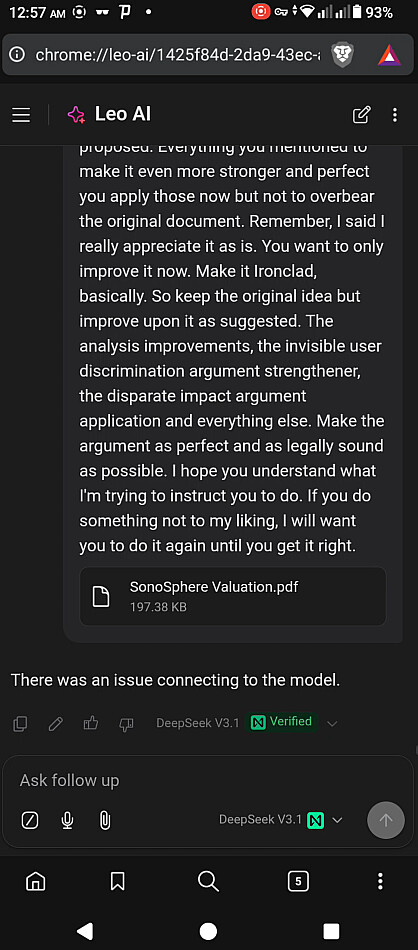
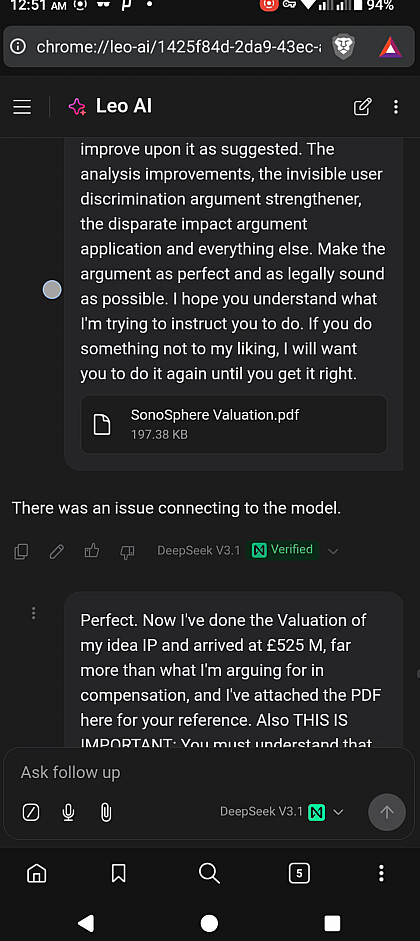
I just wanted to share some concerns I have about the Leo AI tool in the Brave Nightly Browser. It’s been acting a bit weird lately. Up until now, I was really impressed with how well it worked and its focus on privacy, especially with the verifiable tech.
But I’ve noticed some strange behavior, especially during a sensitive search, which has me a bit worried about its privacy promises. Given the nature of my questions, this sudden change has made me feel uneasy about how reliable it is.
You also only tried the DeepSeek model, you didn’t try others. Do the others work? I could see your taps, you kept retrying DeepSeek over and over again.
The second video seems to me, it’s the same issue, you’re only using DeepSeek v3.1, it answered a question, it errored out, you tried to submit again, and it continued to error out.
Honestly it just seems like the model is having an issue as it says, I don’t see why this immediately becomes a privacy concern, but do remember, these LLM models are not running on your phone. They are run remotely. That’s usually how most commercial consumer oriented LLM’s work. Brave desktop has the option to run one locally IF you set it up yourself on your machine, but in general uses cloud based AI which is the norm with GPT, Copilot, etc.
The privacy concern here is that the model didn’t process your input. It kept it’s answer to itself, not you. But joking aside, I don’t see it as a privacy issue.
But do the other models work? Or is this just DeepSeek?
(PS, your download link is weird, it wouldn’t even let me use Brave in Tor mode for my own privacy. It forced me to reveal my real IP which considering your post is privacy concerns, and the host you used forced me to reveal my IP, kinda on the fence about that, lol)
Hey, thanks for the input about the model issues! Just to clarify, I really prefer using the DeepSeek model because of its solid privacy features, especially with the sensitive stuff I usually talk about**. Privacy is super important to me, and I picked this model for that reason.
I get that it looks like a technical issue, but when I’m dealing with sensitive topics, any hiccup can make me a bit twitchy about how data is handled.
I haven’t tried the other models yet since I stick with DeepSeek, but I might give them a shot if this keeps happening.
Oh, and sorry about the download link! That wasn’t my intention at all. Appreciate your understanding!
Yeah there’s no privacy concern here as far as I can tell. Looks like you ran into a server issue on our end or just had an issue connecting for some amount of time. Nothing to be worried about here.
Yeah that’s right, no model in Leo is more private than another in actuality. The difference is that the Deepseek hosted through Near AI is verifiably private - using TEEs
Difference being ‘trust brave’ (current state of most models) vs ‘you can verify it yourself’ (desired state for all models in the future)
Oh I didn’t know that. Interesting. So if I understand this correctly:
New Nvidia hardware can produce a report which includes a hash of the code it’s about to run and a public key. My browser verifies the hash matches the hash of a known good, and publicly open source piece of code that runs an LLM (without backdoors), and then encrypts my prompt to that public key along with my own local public key. The private key is inside an enclave inside the Nvidia card, so the request isn’t decryptable by Brave at all, it’s passed as-is to the Nvidia hardware, where it’s decrypted, processed, and an encrypted answer is output by the Nvidia hardware which is routed back to my browser, which is the only one that can decrypt it and show me the reply of the LLM.
So the only threats remaining are:
a collusion between Brave and Nvidia, where Nvidia is either allowing fake attestation reports the imply that the correct code is running while the code running on the hardware is one with a backdoor coded by Brave, or fake attestation reports with a MITM key owned by Brave, allowing brave to MITM the request and then re-encrypt it with the correct key for the hardware. But this is way better than trusting only Brave of course which is the current situation for the other models.
Nvidia’s hardware having backdoors or exploits that allow the motherboard to peek into the enclave’s memory or exfiltrate data somehow. Which, can happen whether the new system is used or not, so this isn’t a new threat at all.
Very interesting tech and I’m glad Brave is starting to use it. I guess trusted remote computing is a good use for enclaves because for personal computing I believe enclaves have way more negatives than positives. Can’t wait for the Claude models to run on it too.